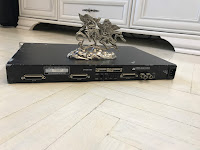
Apogee AD-16X 16-channel, 192kHz A/D Converter w/C777 Clocking Technology V1 loaded with an X-HD card, 2003, made in USA
ADA Microcab Miked Guitar Cabinet Emulator mk1, 1980s, made in USA
Link: elektrotanya [Service Manual] | [Owner's Manual ADA Microcab mk2] | adadepot [Upgrade ADA Microcab]
The Microcab is a fully analog guitar cabinet with mic simulation. Connect it like this: guitar > preamp > Microcab > line input (mixer, sound card, etc.) or power amp.
The device has two channels so you can use it in stereo mode. It also has Dry outputs for A/B signal comparison.
This unit has few competitors in the analog world since most simulations are now digital. With this device you don't have any AD/DA conversion which is an advantage.
Choose a cabinet type (one speaker, two speakers, four speakers, open, closed, vintage, modern...). Two additional controls adjust high and low overtones created by the mic's proximity effect.
Jack and XLR connectors, stereo. 1U RACK transformer.
Транзистор полевой ОПЫТНЫЙ КП802А Silicon Transistors, made in USSR
Brand: НЭВЗ СОЮЗ (Новосибирск)
Country of manufacture: USSR
Type of transistor: Field
Housing material: Metallic glass
KP802A transistors silicon epitaxial and planar field with a lock on the basis of p - n of transition and the vertical channel of n - type switching.
Field transistors 2P802A, KP802A, KP802B are intended for application in converters of constant tension, the high - speed switching devices.
Are issued in the metal case with glass insulators and rigid conclusions.
The type of the device is specified on the case.
The mass of the transistor is no more than 20 g.
Case type: KT - 9 TO - 3.
Specifications: aa0.336.812 TU.
Tewa TG72 = Tewa ADP672 = Tewa ADAP72 Germanium Transistors, 1964-1969, made in Poland
Link: radiomuseum | mif.pg.gda | elenota [Datasheet, PDF]
Изначально выпускался под маркировкой TG72, позже был переименован в ADP672 и ADAP72.
Country: Poland
Brand: TEWA, Fabryka Półprzewodników Tewa; WarschauTube type: Transistor Power/Output
Identical to ADP672 = TG72
Predecessor Tubes TG72
Base SPECIAL TUBEBASE in general
Filament Solid State
Description PNP germanium alloy transistor intended as AF power amplifier / switch.
Dimensions (WHD): incl. pins / tip 39 x 9 x 27 mm / 1.54 x 0.35 x 1.06 inch
Weight: 12 g / 0.42 oz
Information source: Manufacturers Literature Datenblatt TEWA
Selling price PLN 150, retail price PLN 220 (1964). Pair: sales price PLN 310, retail price PLN 500 (1964).
P=10W(tcase=25oC); UCE=60V; IC=1.5A; tJ=75oC
fT>0.1MHz; ICB0<100μA; h21e=30
Tungsram ASZ1015 Germanium Transistors, made in Hungary
Country: Hungary
Brand: Tungsram; Budapest (see also British T.)
Tube type: Transistor Universal
Identical to ASZ1015
Similar Tubes: Normally replaceable-slightly different: ASZ15
Base SPECIAL TUBEBASE in general
Filament Solid State
Description: PNP germanium junction transistor for power switch applications.
Text in other languages (may differ)
Dimensions (WHD): incl. pins / tip 25 x 39 x 10 mm / 0.98 x 1.54 x 0.39 inch
Weight: 14 g / 0.49 oz
Information source: KTT 1969/70
Radionette Soundmaster SM40-1C[T], 1973, made in Norway
Link: radiomuseum | tomania1953
Radionette Soundmaster SM 40 C 1971 - 1976Design: Ing. Oddbjørn Grønnevik
RadioVisjon og Radionette Ingeniør og Designer
Country: Norway
Manufacturer / Brand: Radionette; Oslo
Year: 1973
Semiconductors (the count is only for transistors) Semiconductors present.
Main principle Superheterodyne (common)
Wave bands Broadcast, Long Wave and FM or UHF.
Details Cassette-Recorder or -Player
Power type and voltage Alternating Current supply (AC) / 115-230 Volt
Loudspeaker - This model requires external speaker(s).
Power out
Model: SM-40C - Radionette; Oslo
Material Wooden case
Shape Tablemodel, slant panel.
Mentioned in The Norwegian Historical Radio Society
Genelec HT205 / Genelec 1029A / Genelec 8030A Active Studio Reference Monitor, 1999-2006, made in Finland
Link: medias.audiofanzine.com | ACOUSTIC AXIS LOCATION | asktoby [Repair]
Powered speaker pair is the Genelec 1029 (The 1029A was in production between 1996 and 2005. It was replaced by the 8030A) and it’s twin sister the HT205. The difference being that the 1029a has XLR and TRS inputs. The HT205 has XLR and RCA. Genelec 2029a with digital audio input (The 2029A was in production between 1998 and 2005. It was replaced by the 8130A model).
Grundig HiFi-Box 406, 1972-1975, made in Germany
Link: radiomuseum | hifi-wiki
Country Germany
Manufacturer / Brand Grundig (Radio-Vertrieb, RVF, Radiowerke)
Alternative name: Grundig Portugal || Grundig USA / Lextronix
Year 1972–1975
Category Loudspeaker, headphone or earphone
Wave bands - without
Power type and voltage No Power needed
Loudspeaker 2 Loudspeakers
Material Wooden case
Model: HiFi-Box 406 - Grundig Radio-Vertrieb, RVF,
Dimensions (WHD) 240 x 580 x 240 mm / 22.8 x 9.4 x 9.4 inch
Notes:
- Impedance: 4 ohm
- Power handling (continuous / music): 25/40 W
- Frequency response: 40-20000 Hz
- Transition ranges: 2,500 Hz
- 1 Tieftöner 204 mm (marked: Grundig 7019-007 4 Ohm 25W <30Hz)
- 1 Kalottenhochtöner 115x115 mm (marked: Grundig 709728)
- Color: walnut, rosewood
Net weight (2.2 lb = 1 kg) 10.8 kg / 23 lb 12.6 oz (23.789 lb)
Price in first year of sale 248.00 DM
Source of data Handbuch VDRG 1972/1973
Mackie Big Knob revision C01 Studio Command System [monitor switching and level control box letting], 2005, made in China
Link: Manual PDF | soundonsound
Specifications
Frequency ResponseLine-level Inputs and Outputs:
- +0, –1 dB, 10 Hz to 50 kHz
- +0, –3 dB, 5 Hz to 100 kHz
RIAA Equalization Deviation (Phono Input): ± 0.5 dB from 20 Hz to 20 kHz
Distortion (THD & IMD)
Line-level Inputs to Line-level Outputs (unity gain): > 0.015%, 20 Hz to 20 kHz @ +4 dBu
RIAA Input, Nominal Gain: > 0.015%, 20 Hz to 20 kHz @ +4 dBu
Noise Floor
(20 kHz Bandwidth, +4 dB level setting, 150Ω source)
Monitor A, B, and C Outputs, Studio Output, DAW, 2-Track A, and 2-Track B Outputs: –90 dBu typical
Phono Input (nominal 41.8 dB gain @ 1 kHz, inputs shorted): –71 dBu maximum (all outputs)
Equivalent Input Noise (E.I.N.): 0.89 μV / –119 dBu maximum
Beag AEX-251 Tube Amplifier, 1969, made in Hungary
Country: Hungary
Manufacturer / Brand: Budapesti Elektroakusztikai Gyár (BEAG), Budapest
Year: 1969 ?
Category: Audio Amplifier or -mixer
Valves / Tubes 8: EF86 EF86 ECC808 ECC808 ECC808 ECH81 EL34 EL34
Main principle Audio-Amplification
Wave bands - without
Details
Power type and voltage Alternating Current supply (AC) / 220 Volt
Loudspeaker - This model requires external speaker(s).
Power out 70 W (unknown quality)
Radiomuseum Model: AEX-251 - Budapesti Elektroakusztikai Gy
Material Metal case
Shape Tablemodel, with any shape - general.
Dimensions (WHD) 330 x 140 x 400 mm / 13 x 5.5 x 15.7 inch
Net weight (2.2 lb = 1 kg) 12.5 kg / 27 lb 8.5 oz (27.533 lb)
Literature/Schematics (1) Rádiótechnika, 1969.
Radio Shack Realistic model no.: 42-2108 Analog Stereo Reverb System, 1985, made in Korea (China)
Link: hifiengine | groupdiy | audiofanzine | audioimprov
Экземпляры маркировались made in Korea & made in China
While scrounging in the closet, I came across this Radio Shack Realistic Stereo Reverb System. It’s kind of cool in a retro ‘80s way. It’s based on an analog bucket brigade chip, which is a bit like dynamic RAM, but the voltage stored in the capacitors of the delay line is analog instead of 1s and 0s. The stored signal is moved one capacitor farther down the delay line with each clock pulse, so the delay time varies with the clock frequency. Fast clock, short delay, slow clock, long delay.
It has a mic input for karaoke or recording to your Realistic cassette tape recorder with reverb. It would normally be hooked to your stereo receiver through the tape in & tape out jacks, so it has pass through jacks to hook the tape deck to.
The side panels are molded plastic with a wood grain print to complement the rest of your equipment. The brushed and anodized front panel.
The delay or echo time ranges from a few milliseconds for a doubling or flanging effect, to 1/10 second, for a distinct echo. Twisting the delay knob while recording creates weird effects, because sound is clocked out of the delay line at a different rate than it went in, causing pitch to drop when delay is increasing, and rise when delay is decreasing. These are also sought after as guitar effects. The mic input distorts and sustains with a guitar, and the delay adds its own goodness and body.